


The debate between monofilament and braided line is one of the most common topics of discussion both at the water’s edge and on fishing forums. There is no one-size-fits-all answer to the question of which is better. Each material has its own unique physical properties that make it ideal for specific situations, techniques, and target fish. In this detailed guide, we’ll break down the mechanical properties of both materials, examine how they affect lure presentation, and advise you on when to stick with the classic nylon and when to leverage the uncompromising strength of modern braided lines.
Basic characteristics and mechanical properties of monofilament line
Monofilament line, often simply referred to as nylon, is made from a single continuous polymer fiber. Its greatest strength and, at the same time, its weakness is its high stretch. The line can stretch by 15% to 30% of its length before breaking, which makes it an excellent shock absorber. When fishing at close range or in situations where the fish fights with aggressive lunges, the line absorbs these shocks and prevents the hook from being pulled out of the fish’s mouth.
Another important factor is its surface. The line is smooth, has a circular cross-section, and is much less visible to fish in the water than monofilament line due to its refractive index. It also has natural buoyancy or slight sinkability, depending on the specific type of polymer.
On the other hand, a disadvantage of monofilament line is its so-called shape memory. If you leave the line on the reel for a long time, it tends to twist into spirals after casting, which shortens the casting distance and reduces sensitivity when the lure makes contact.
Main Advantages and Disadvantages of Classic Fishing Line
Thanks to its affordability and versatility, monofilament line remains the most widely used material. Among its main advantages is high abrasion resistance. Furthermore, when monofilament line is slightly scratched, its breaking strength decreases gradually, whereas with braided line, a single cut fiber is enough for the entire setup to give way under tension.
However, a disadvantage of monofilament line is its susceptibility to UV radiation and aging. Sunlight and temperature fluctuations cause the line to become brittle over time and lose its strength, especially at the knots. It is therefore necessary to replace it regularly, ideally once a season, if you spend a lot of time by the water.
Its sensitivity when fishing at long distances is also negligible. If you’ve cast 100 meters out, the line’s stretch will cause a delayed strike and very weak contact with the fish.
Why braided line is a revolution in modern spinning and predator fishing
Braided line, also known as braided line, consists of several microfibers (most commonly Dyneema or Spectra) that are braided together into a single unit. The number of strands (four-strand, eight-strand, or twelve-strand) determines the roundness and smoothness of the line.
How braided line differs from monofilament
The key difference from monofilament is its nearly zero stretch, which allows anglers to maintain absolute contact with the lure. You can feel every pebble on the bottom, every snag on the weeds, and above all, even the slightest contact between the fish and the lure.
Thanks to its incredible tensile strength combined with a very small diameter, braided line allows for extremely long casts and rapid sinking of the lure through the water column, as it offers much less resistance to the water than a thicker monofilament line of the same breaking strength.
However, the line lacks any elasticity, which means that all the pressure during the fight must be absorbed by the rod, the reel’s drag, and the angler’s hands. Additionally, the line is opaque and highly visible to fish in clear water, a factor that must be taken into account when fishing.
Quick comparison of monofilament and braided line in a table
|
Property |
Monofilament line |
Braided line |
|---|---|---|
|
Elongation |
High (15–30%) |
Almost zero (1–3%) |
|
Sensitivity |
Lower (dampens signals) |
Extreme (transmits everything) |
|
Abrasion resistance |
Very high |
Lower (frays easily) |
|
Diameter |
Thicker diameters |
Very thin yet strong |
|
Visibility in water |
Low (transparent) |
High (colored, opaque) |
|
Lifespan |
1 season (degrades due to UV exposure, among other factors) |
2–4 seasons (mechanically stable) |
|
Use in freezing conditions |
No problems |
Absorbs water and freezes |
Differences in stretch and their impact on a successful hookset
Stretch is probably the most important factor in making a decision. Imagine a situation where you’re fishing for zander with a rubber lure at a distance of 40 meters.
If you use monofilament line, when setting the hook, you must first overcome the “slack” and then several meters of stretch in the material itself before the force is transferred to the hook. The result is often a missed strike, with the fish merely holding the lure in its mouth and spitting it out near the shore. Here, braided line with zero stretch dominates, because the striking force is immediate and uncompromising.
For trout and bass, use monofilament
On the other hand, when fishing for trout or perch, which have soft mouths, zero stretch in the line can be a disadvantage. An aggressive lunge by the fish near the shore often ends with the hook being cut out or even the thin leader snapping, because the rig has no give.
In these cases, monofilament line acts as a safety feature that forgives the angler’s mistakes and an overly tight reel drag. It is, simply put, a trade-off between perfect lure control and safely landing the fish.
Visibility of the line underwater and the wariness of predators
The visual aspect is absolutely crucial in clear waters. Braided line is made of opaque fibers and looks like a thick rope underwater, which can reliably deter wary fish such as large trout, chub, or experienced asp. Although manufacturers try to dye the lines in natural shades of green or brown, they cannot change the physical nature of the material. Braided line will always be more visible in the water column than clear nylon.
In clear water, go with monofilament
Monofilament has a refractive index close to that of water, making it nearly invisible. If you’re fishing in crystal-clear sand pits or mountain streams, monofilament will get you many more bites.
While there are special fluorescent monofilaments designed to help anglers see the line’s direction above the surface, these materials still perform better underwater than braided lines. If you still want to use monofilament for its sensitivity, it’s essential to combine it with a long leader made of invisible fluorocarbon, thereby eliminating its visual disadvantage.
Resistance to abrasion and mechanical damage in challenging terrain
If your favorite fishing spots feature rocky bottoms, sunken concrete slabs, or sharp edges, braided line will be a nightmare for you. The fine fibers of braided line are susceptible to mechanical damage. As soon as the line rubs against a sharp edge of a rock under tension, the fibers begin to fray and the breaking strength drops drastically to zero. Often, even a brief contact is enough for the line to snap like a thread.
Only use monofilament in challenging terrain
In this regard, monofilament line is a “workhorse.” Its tough surface can absorb scratches and gouges without snapping immediately. In carp fishing, so-called shock leaders with large diameters (0.50 mm and up) are used in extreme conditions; these are specifically designed for contact with the sharpest obstacles.
If you know you’ll be pulling fish through fields of water lilies or over rocky banks, monofilament line is the safer choice, saving you from losing lures and fish unnecessarily.
Specifics of fishing in freezing weather and during the winter months
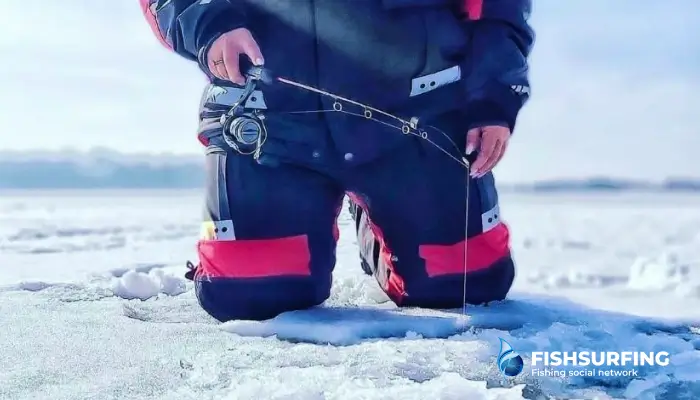
Winter fishing presents one major problem for braided lines: water absorption. Even the highest-quality lines with a surface coating absorb water to some extent. Once the temperature drops below freezing, the water in the gaps between the fibers freezes. The line then stiffens, rubs against the rod guides, and in extreme cases can damage the ceramic inserts in the guides or start tearing on the reel spool due to sharp ice crystals.
In winter, rely on monofilament line
Monofilament line does not absorb water. Even in severe frost, it remains relatively supple and passes smoothly through the rod guides. If you’re planning on winter spinning or ice fishing, monofilament line is the clear winner.
While there are special sprays for lines designed to reduce freezing, their effectiveness is short-lived. For trouble-free winter fishing without constantly scraping ice off the guides, classic nylon is irreplaceable.
Fluorocarbon as a bridge between monofilament and braided line
Many anglers today refuse to give up the advantages of braided line, but at the same time recognize its limitations in clear water or when encountering obstacles. The solution that combines the best of both worlds is the use of a fluorocarbon leader.
Fluorocarbon is a unique material with a refractive index nearly identical to that of water, making it virtually invisible to fish. At the same time, it is much stiffer and more abrasion-resistant than standard monofilament or braided line.
If you combine braided line with a one-meter or longer fluorocarbon leader, you get a setup that has zero stretch and extreme sensitivity, yet remains invisible to the fish and resistant to being cut by rocks in the final meter near the lure.
The Use of Braided Line and Monofilament in Various Fishing Techniques
Each fishing discipline places different demands on the material. While braided line is indispensable for one technique, it can be downright detrimental for another.
Modern feeder fishing and long-distance casting
When feeder fishing, especially if you’re casting beyond 40 meters, braided line is a huge advantage. Thanks to its zero stretch, you’ll see even the slightest twitch on the rod tip—a movement that monofilament would absorb at such a distance. Braided line allows for an immediate hookset.
However, in the final phase of the fight, when the fish tends to thrash its head wildly, it is necessary to supplement the braided line with a so-called feeder rubber or a longer monofilament leader, which cushions the final lunges and prevents the hook from being cut out.
Carp Fishing and Long Casts vs. Baiting
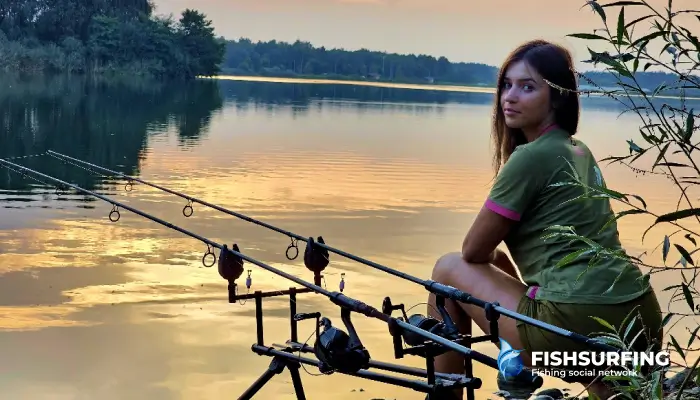
Carp anglers often face the dilemma of choosing between braided line and monofilament. For extremely long casts, braided line is unbeatable thanks to its small diameter. Even more important, however, is its role in long-distance bait deployment from a boat.With a classic monofilament line, you could easily miss even a strong strike at such a distance, because due to water resistance and the fish’s pull, the line would simply stretch out and the rod tip would remain still.
Conversely, in smaller waters and when fishing right at your feet, monofilament wins out due to its inconspicuousness and ability to dampen the lunges of strong fish, which reduces the risk of damaging the carp’s mouth.
Float fishing and fishing with light tackle
In float fishing, where very light floats and delicate rods are used, braided line has almost no place. Monofilament dominates here due to its transparency and the fact that it “sits” better on the surface or sinks more easily beneath it (depending on the type).
Braided line also tends to get tangled more often in the fine guides of float rods. In float fishing, the priority is the natural presentation of the bait, which braided line tends to disrupt due to its stiff and opaque nature.
Choosing the Right Line and Braided Line Diameter for Different Situations
Choosing the right line thickness is an art of compromise. The thinner the line you use, the farther you can cast, and the more naturally the lure will behave in the water. At the same time, however, you risk losing the fish in obstacles.
- With braided lines, focus on the breaking strength in kilograms rather than the diameter in millimeters, as measuring the thickness of braided fibers is imprecise. For standard perch spinning, lines with a breaking strength of around 3–5 kg are sufficient; for pike and zander, choose 8–12 kg; and for catfish fishing, go uncompromisingly for 30 kg and above.
- For monofilament line, diameter is key. For light float fishing or feeder fishing, use 0.12 mm to 0.18 mm. For classic carp fishing, the standard is 0.28 mm to 0.35 mm. Always remember that a knot reduces the line’s breaking strength by 10% to 30%, so choose a diameter with sufficient margin.
Final verdict and recommendations
There is no clear winner, but there is the right choice for the moment. If you’re just starting out with fishing, monofilament line is the safer and more forgiving choice for you. It will forgive mistakes during the fight, an improperly adjusted drag, and even poor casting technique. However, if you want to take your game to the next level, especially in disciplines like spinning or feeder fishing, braided line will open up entirely new possibilities.
And the ideal approach? Having both options available—either on spare spools on your reel or in the form of a combined setup with braided line and fluorocarbon.