

Choosing a fishing spot—often referred to by anglers as a “swim” or “spot”—is the most important decision of the entire trip. You can have the most expensive lures, the most modern rods, and the most precise rigs, but if you cast where the fish aren’t, you’ll end up just watching from the shore. So let’s take a look at how to read the water and understand the logic behind fish behavior so you can make the right choice even in a completely unfamiliar fishing spot.
Preparation starts with a digital survey of the fishing spot
The days of heading out to unfamiliar waters with just a paper map and a hunch are long gone. Today, you have tools at your fingertips that can significantly shorten your search time and suggest where it makes sense to start. So if you want near-guaranteed success, the first step should always be basic digital preparation.
Fishsurfing as a practical starting point
Before you even load up the car, open Fishsurfing and browse the map of fishing spots. It’s not just about finding your way to the water. Take a look at shared catches, photos, reviews, and other content from anglers.
You can often glean more from photos than meets the eye. For example, if photos from a clearly similar spot repeatedly appear near your chosen fishing spot, that could be a good sign of where to start. Fishsurfing also offers community and discussion content, so you can review other anglers’ experiences in advance and get a better idea of the location.
Satellite maps as an additional layer of information
Google Maps or Mapy.cz in satellite view can also be very useful for anglers. Especially in clearer and smaller bodies of water, details that are easy to overlook upon arrival are often clearly visible. Just keep in mind that a satellite image may not reflect the current water level or season, so it’s always more of a guide than a definitive answer.
Shoals and shallows
Lighter areas in the water often indicate sandy shoals, raised bottoms, or shallower sections. This is exactly where fish often gather to feed, especially during the warmer months or during morning and evening activity.
Underwater vegetation
Darker, irregular patches below the surface may indicate patches of aquatic plants. For whitefish, they are a source of food and shelter; for predators, they are a vantage point from which to attack.
Coves and rugged shores
On the satellite map, also look for various promontories, corners, narrows, or calmer sections of water. Rugged sections are often more interesting than long, straight banks without any significant structure.
Inflows and outflows
Places where water flows into or out of the fishing area are often of interest to anglers due to water movement, higher oxygen levels, and naturally carried food.
Flooded riverbeds and old bottom lines
Near dams or larger reservoirs, look for lines that may indicate the original riverbed, an old path, or a break in the terrain. Fish often use such features as natural routes between shallow and deep water.
Piers, dams, and other prominent landmarks
Various fixed points on the shore or in the water can help you not only with orientation but also with identifying promising spots. Small fish often gather around such structures, and predators follow them.
Access points and shore fishing opportunities
A satellite map will also show you where you can reasonably walk to the water, where there is space to set up your gear, and where, conversely, the shore looks difficult to access or overgrown.
What to look for first upon arriving at the water
In an unfamiliar fishing spot, it’s ideal to do a quick survey of the shore. Before deciding where to sit, walk along at least a short stretch of the water and note a few basic things. These will very quickly give you a clue as to where something might be happening.
The shape of the bank and the water’s structure
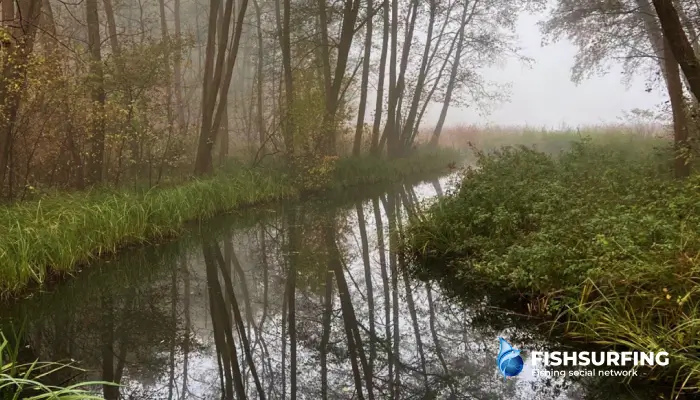
Just looking at the fishing spot often reveals a lot. Coves, promontories, narrows, tributaries, or places where the bank breaks sharply are usually more interesting than long, straight stretches without any significant structure. Fish like structure because it’s usually associated with changes in depth, current, or the presence of food.
In still water, bays, shallows transitioning into deeper water, edges, and areas near tributaries are particularly interesting. On a river, on the other hand, it pays to look for current edges, calmer pockets, eddies, or deeper sections beneath obstacles.
Wind and its direction
Wind is one of the most underestimated factors, yet it can have a huge impact. In still water, it often pushes warmer water, food, and small fish toward one bank. And where food accumulates, there’s a good chance the fish will gather there too.
This isn’t always true under all circumstances, but if the wind is blowing steadily toward one bank, it’s definitely worth focusing on that side of the fishing spot. For carp, whitefish, and predators, this is often a strong signal. The calm, still side of the water, on the other hand, may look inviting but be much less productive for fishing.
Activity on the surface and near the shore
Sometimes the water will give you a clue on its own. Bubbles near the bottom, small ripples on the surface, schools of fry, fish gathering, or occasional strikes by predators are exactly the signals an angler should watch for in an unfamiliar fishing spot.
If you see small fish moving, that’s a good sign. Where there are fry and whitefish, there is usually life. And where there is life, there is also a higher chance of active fish higher up the food chain. Conversely, a completely still surface with no sign of activity can be a warning that the spot won’t be particularly productive.
Obstacles and Cover
Fallen trees, branches in the water, reeds, water lilies, submerged bushes, rocks, or transitions between clear water and vegetation all have one thing in common: they give fish a sense of security and create zones where food congregates. For predators, these are natural strike points; for carp and whitefish, they serve as orientation points and resting spots.
In unfamiliar waters, it is almost always better to start near some structure rather than in completely “bare” water devoid of life. You just need to adapt your tactics and gear accordingly, as the risk of snags is usually higher.
How to quickly assess what’s happening below the surface
You can’t see everything from the shore, but you can deduce a lot of things. The faster you get a sense of the depth, bottom, and transitions, the easier it will be to choose a spot where you have a chance of a successful catch.
Water color and changes in hue
Even without a fish finder or marker, you can often estimate where the shallows are and where there is greater depth. Lighter zones tend to be shallower, while darker sections may indicate depth or a change in the bottom. Furthermore, if you see a band of a different color, it could be an edge, a transition from gravel to mud, or another structure that tends to attract fish.
These differences are easier to read in clearer water and harder to see in murky water, but it’s still worth observing whether the water appears uniform or if there are breaks and changes in it.
Wave and Surface Behavior
Wind and waves sometimes highlight what would otherwise be less visible. Depth transitions, bottom elevations, or submerged obstacles can manifest as different ripples on the surface. It’s not a foolproof rule, but in unfamiliar waters, every such detail is valuable.
Where the water behaves differently from its surroundings, there is a reason to pay closer attention. Often, such spots are more interesting for fishing than uniform stretches without variation.
Test casts and contact with the bottom
Once you’ve identified a few promising spots, a few test casts can be helpful. Whether you’re feeder fishing, spinning, or carp fishing, that first contact with the bottom will tell you a lot. Do you feel a hard impact? Soft mud? Grass? An edge? Rocks? All of this is information that will help you decide whether to stay or move on.
In an unfamiliar fishing spot, it’s a huge mistake to fish “blindly” without trying to figure out what’s beneath you. Often, just a few minutes are enough to tell whether you’re casting into an interesting area or a completely empty zone.
A pond is read differently than a river, and a reservoir differently still
One of the biggest mistakes on unfamiliar waters is assuming that everything works the same way. But choosing a spot on a small pond is different from choosing one on a river, and completely different on a large reservoir. Every type of fishing spot has its own rules.
How to choose a spot on a pond or smaller body of standing water
Smaller still waters may seem more straightforward at first glance than a river or large reservoir, but they can be treacherous. Fish here rarely hold randomly, and it’s very easy to make a mistake if you choose a spot based solely on convenient access or an open bank.
- Look for transitions between shallow and deep water. These zones are often the fish’s natural migration routes, as they are close to both food and safer, deeper water.
- Pay attention to reed beds, tributaries, and outflows. Such spots often offer more food, cover, and natural water movement, and are therefore usually more interesting for fishing than open, bare water.
- Don’t assume that fish will be far from the shore. In smaller bodies of water, they are often surprisingly close, especially if there is calm water, vegetation, or natural cover near the shore.
- In the spring and during warmer periods, focus on warmed-up shallows. The water heats up faster here, and fish gather here for activity and food.
- In summer, look for shadier or deeper parts of the fishing spot. In the heat, the temperature there is usually more pleasant and conditions more stable than in completely open shallows.
- Also take the wind into account. If it’s blowing toward a certain bank, it can push food and small fish there, so it makes sense to start from that part of the fishing spot.
How to choose a spot on a river
A river is read differently than still water. Here, it’s not just the spot itself that matters, but mainly what the current does and how fish can move through it with the least amount of energy expenditure.
- Look for spots where the current brings food, but where the fish don’t have to struggle unnecessarily. It is precisely this combination of food supply and a calmer resting spot that is crucial on a river.
- Focus on the edges of the current and eddies. These are spots where stronger and weaker currents meet, and fish often linger here, gathering whatever the current brings.
- Sections below weirs, near bridge piers, or behind rocks work well. Calmer pockets form in all these places, providing fish with cover and a good position for gathering food.
- Pay attention to deeper and calmer sections away from the main current. That’s exactly where fish that don’t want to be right in the strongest current often stay.
- Don’t automatically sit in the middle of a strong current just because the water “looks lively.” At first glance, such a spot may seem promising, but fish much more often hold the transitions and calmer zones rather than the main current itself.
- Look for spots where the current changes. Every narrowing, widening, change in depth, or obstacle in the water can create an interesting spot where it makes sense to start fishing.
How to Choose a Spot on a Reservoir
For an unfamiliar angler, a reservoir is often the most challenging of all water types. It’s large, complex, and it’s easy to make a mistake by choosing an open area without a clear reason. That’s why it pays to think as strategically as possible when fishing a reservoir.
- Don’t try to cover the entire body of water at once. It’s much better to identify a few logical spots and focus on them than to sit aimlessly on a vast open expanse.
- Start with coves and tributaries. Such spots are naturally attractive because they provide food, changing conditions, and fish movement.
- Look for old riverbeds, steep drops, and edges. Fish often use these lines as natural routes between deeper and shallower water.
- Pay attention to stone dams and other prominent structures. Fish often orient themselves around landmarks in large bodies of water just as they do in smaller fishing spots.
- Also keep an eye on the wind and its direction. On a reservoir, the wind can play a very important role, as it shifts food and fish activity to certain parts of the reservoir.
- On large bodies of water, always look for specific situations. A spot without a clear structure or reason is often much less productive on a reservoir than a section where depth, wind, a tributary, or a distinct edge converge.
How to Choose a Spot Based on Fishing Technique
This is important: there is no such thing as a universally good spot. A spot that makes sense for feeder fishing may not be good for spinning. And a carp angler will often choose a completely different position than an angler using a light rod.
Feeder and float fishing
With feeder and float fishing, you’re looking for a spot where it makes sense to keep the fish there by feeding them. What matters is a clear view of the bottom, a reasonable distance, accessibility, and the likelihood that fish will pass through the area. Edges, calmer sections, bottom transitions, or spots where the wind pushes food work well.
In an unfamiliar fishing spot, it’s best to start simply: find a clear section, map out the bottom, and only then set up a feeding spot. Observe first, then feed.
Spinning
When fishing in unfamiliar waters, a spin angler should focus primarily on cover, obstacles, edges, and the movement of whitefish. Predators rarely linger in open water without a reason. Look for reeds, rocks, submerged branches, tributaries, current breaks, and spots where something is changing.
Another advantage of spinning is that you’re not tied to a single spot. In unfamiliar waters, it’s often better to move around than to sit in one place for too long. When the water is quiet, change your angle, depth, or even move along the bank.
Carp Fishing
A carp angler on unfamiliar water mainly looks for calm conditions and logical fish migration routes. These can include edges, depth transitions, tributaries, coves, submerged obstacles, or the windward side of the water. However, it is also crucial whether you are able to read the spot and fish it accurately.
Carp does not automatically mean “as far from the bank as possible.” On the contrary, in many waters, they can be caught very well even relatively close to shore, provided the fish have a reason to swim there.
Unknown water is a challenge, not a bogeyman
If you don’t know the fishing spot at all, the best thing you can do is not to rush at the beginning. Don’t automatically cast your first rig into the water right away, but first assess the bank. See where the wind is blowing from, where the water breaks, where there is cover, where there is movement, and where, on the contrary, the water seems dead. It is often those few extra minutes that determine whether you’ll be fishing for active fish or just waiting for something to happen.
Choosing the right spot in a fishing area you don’t know at all is one of the most rewarding aspects of fishing. Don’t see it as a source of stress, but as an adventure. Every unsuccessful cast teaches you where the fish aren’t, and every bite in a new spot confirms that you’ve correctly solved the puzzle nature has set for you.