


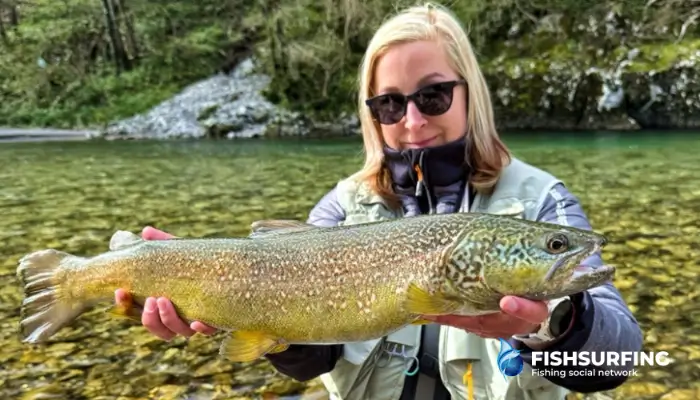
Fly fishing isn't just about which fly you tie to your leader. It’s just as important to understand what’s happening in the river—where the current carries food, where fish seek shelter from the strongest currents, where they wait for insects, and where it’s rarely worth wasting your time. It’s precisely this ability to read the river that often determines whether you’ll just be casting nicely or actually catch fish.
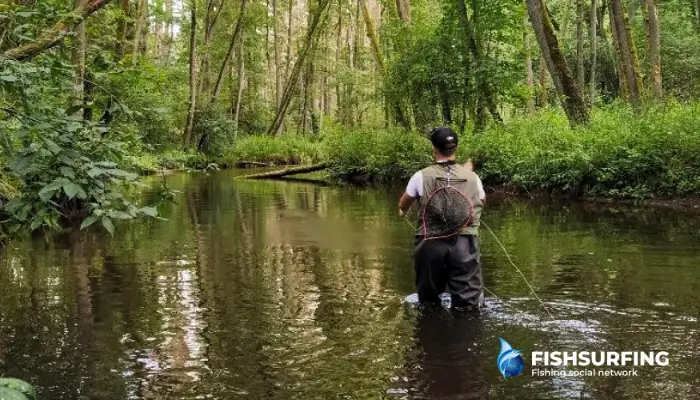
Why Just Knowing How to Cast Isn’t Enough
A nice cast is important in fly fishing, but it’s not enough on its own. You may have good technique, a high-quality rod, and a carefully selected fly, but if you’re casting it into spots where the fish aren’t, the results will be poor. A river isn’t a uniform expanse. Every meter offers different conditions: varying depth, current speed, food availability, and hiding spots.
First, understand why the fish are there
Fish in a river conserve energy. Most often, they stay where food is within reach, but the current doesn’t tire them out unnecessarily. That’s why it pays to observe first and cast only afterward.
This is doubly true for fly fishing. You need to get a dry fly into a natural drift. You must guide a nymph at the correct depth and speed. A streamer, on the other hand, works best where the fish has a reason to strike. Each technique therefore requires a slightly different way of reading the water, but the basic principle remains the same: find a spot where the fish has a reason to be.
What Fish Are Looking For in a River
If you want to read the river correctly, it’s good to think like a fish. Not like a person looking for a nice spot to access the water or a comfortable place to stand. Fish are interested in completely different things.
- Food – The current brings insects, larvae, nymphs, and other small prey to the fish. Places where the current breaks, slows down, or channels food into a single strip are particularly interesting.
- Energy Conservation – Neither trout nor grayling will stand in a strong current for long without a reason. They choose spots where food is within reach, but where they don’t have to struggle unnecessarily against the water.
- Safety – Fish seek cover, depth, shade, or structure that makes them feel safe. An eroded bank, an overhanging branch, a rock, or a deeper pool are therefore often more attractive than open shallows.
- Proper Temperature and Oxygen – In summer, fish often seek out faster-flowing, oxygen-rich sections, shade, or deeper water. In the cooler part of the season, on the other hand, they may stay in calmer spots where they don’t have to expend as much energy.
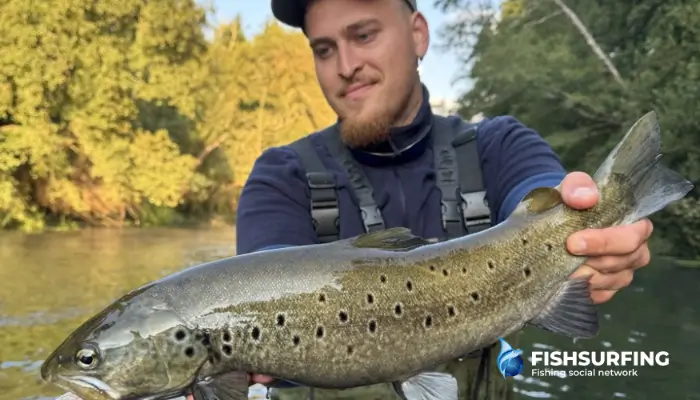
Where Fish Most Often Hold in a River
Every river looks a little different, but certain spots recur in almost every body of water. Once you learn to recognize them, you’ll quickly understand where it makes sense to cast your fly first.
Current Edges
A current edge is where faster and slower water meet. Fish often hold in the calmer section, feeding on prey carried to them by the faster current. On the surface, you can recognize it by a change in the water’s texture. One section flows faster, the other slower, and it’s precisely this interface that’s very attractive to trout and grayling.
Pools Behind Rocks
A calmer pocket forms behind a rock, where fish don’t have to struggle as much against the current. At the same time, the current carries food around the rock, making this a very promising spot. Don’t just fish the area directly behind the rock, but also its sides, where the current flowing around the obstacle rejoins.
Deeper Pits and Pools
Fish mainly use deeper spots when the water is colder, the water level is higher, or when they are being cautious. These spots are particularly promising when they have a drop-off, a current, cover, or a clear supply of food.
When fishing with nymphs, it pays to fish the entrance to the pool, its center, and the outlet. Fish often do not stay directly at the deepest point, but rather at the transition where depth meets the current.
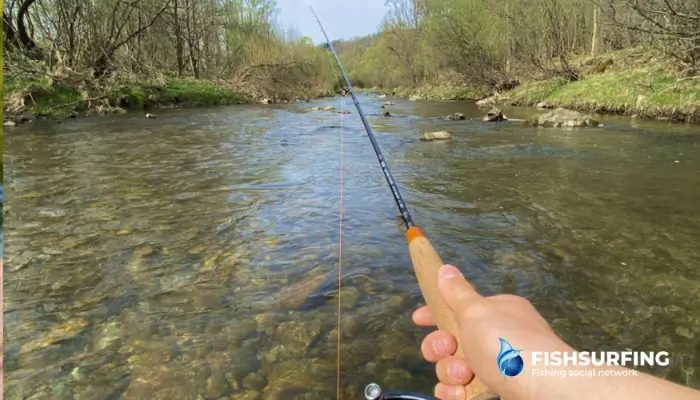
Transitions Between Shallow and Deep Water
The transition between shallower and deeper water gives fish the opportunity to swim out in search of food and quickly return to safety. That’s why it’s often more productive than open shallows alone. Such edges are suitable for dry flies when there’s surface activity, for nymphs during general fishing, and for streamers if you’re looking for larger fish.
Eroded Banks and Overhanging Vegetation
Fish often hold near the bank because they have cover there and insects fall into the water. So be sure not to overlook eroded areas, roots, branches, or overhanging grass. Before entering the water, fish the nearest edge as well. A fish may be just a meter from the bank—sometimes literally right under your feet.
Eddies and calmer side currents
A backwater is a spot where the water flows back against the main current or swirls in a small circle. Foam, leaves, insects, and other food often accumulate there. It’s usually more challenging to work a fly here because the currents behave differently than in the main current. But once you understand where the food is moving, it can be a very interesting spot.
How to Read the Current When Fly Fishing
The current is a map for fly fishermen. It shows where the food is carried, where the water is fast, where it slows down, and where fish might be holding. Once you learn to read the current, you’ll be much better at choosing spots and deciding how to present your fly.
The Main Current Isn’t Always the Best
Beginners are often drawn to the fastest part of the river. It looks lively, the water is moving there, and you get the feeling that’s exactly where the fish will be. But the strongest current tends to be energetically demanding for the fish. Fish may swim out there in search of food, but they rarely stay there for long.
Much more interesting are the spots right next to the main current—where the fast-moving water brings food, but the fish are already in a calmer zone.
Watch for foam and small debris on the surface
Foam, bubbles, leaves, or tiny debris carried by the current show you where the water is carrying food. If these small items stay in a single lane, that’s a good clue. Fish often hold right beneath such food trails.
This is very important when fly fishing with dry flies. If you cast the fly outside the natural food path, the fish may not even notice it. But if you cast it into the right zone and let it drift naturally, you’ll significantly increase your chances of getting a bite.
Pay attention to changes in water velocity
Where the water slows down, speeds up, or eddies, fish behavior often changes as well. Transitions between different current speeds are often much better spots than uniform, unstructured water.
It is precisely these transitions that tend to be good for nymphs. Here, the nymph can reach deeper waters while naturally drifting through the area where fish are waiting for food.
What to Look for Before Your First Cast
One of the best things you can do when fly fishing is not to cast right away. Stop on the bank and just watch the water for a few minutes. Often, within a moment, you’ll see things you wouldn’t have noticed at all if you’d waded in immediately.
Surface feeding
If fish are feeding at the surface, it’s usually revealed by small ripples, splashes, or subtle mouth openings. Not every surface feeding is the same. Subtle ripples often indicate cautious fish or smaller prey, while more pronounced breaks on the surface may signal more active feeding.
When you see surface feeding, a dry fly is the logical first choice. However, it’s important to watch exactly where the feeding is occurring. Fish often feed repeatedly along a single feeding path, not randomly throughout the river.
Insect Activity
Look at what’s flying around the water. Are insects landing on the surface? Are they taking off from the water? Do you see mayflies, caddisflies, midges, or tiny, unidentifiable insects? You don’t need to be an entomologist, but basic observation will tell you a lot.
When nothing is happening at the water’s edge, it’s often better to start with a nymph. When insects are active and the fish are feeding on them, you can switch to a dry fly.
Water Clarity and Depth
Clear, shallow water requires caution, a gentler approach, and more subtle movements. Fish can easily see you and often react to mistakes. Higher or slightly turbid water, on the other hand, can be favorable for nymphs or streamers, as fish tend to be less wary and rely more on movement, contrast, and the current.
Light and Shade
Shade provides important cover for fish. In bright sunlight, they often retreat to the banks, deeper spots, or shaded areas under trees. In the morning and evening, they may even venture into shallower areas where they had been more cautious during the day. Even a spot that’s dead at noon can be bustling with activity in the evening.
Dry Fly, Nymph, or Streamer? How Reading the River Influences Your Choice of Technique
Reading the river doesn’t just help you decide where to cast. It also helps you decide what to tie on. A dry fly, nymph, and streamer aren’t just three different types of flies. They are three different responses to what the water is showing you.
When to Use a Dry Fly
- When fish are feeding on insects at the surface
- When you see ripples, feeding swarms, or surface activity
- In calmer water, at the interface of currents, or along feeding lines
- When you can present the fly naturally without an unnatural pull
When to use a nymph
- When nothing is happening on the surface
- When you suspect the fish are feeding underwater
- In currents, deeper pools, behind rocks, and along edges
- When you need to get the fly deeper into the zone where the fish are holding
When to try a streamer
- When you want to cover a larger area of water
- When you’re targeting active or larger fish
- In higher water, in deeper pools, along the banks, or near obstacles
- When you want to imitate a small fish, a leech, or another more conspicuous bait
How to Improve Your Ability to Read the River
You can’t learn to read the water just from an article. An article gives you a map, but you’ll only gain real experience by the river. Every outing will teach you something new. Sometimes you’ll find that the fish were right by the bank. Other times, you’ll realize that the most picturesque pool wasn’t as good as an inconspicuous current edge a few meters upstream.
It helps to notice the connections. Where did the strike come from? What was the depth? How fast was the current? Was the fish resting behind an obstacle, or in an active feeding zone? Which fly worked, and how was it presented? As you begin to commit these details to memory, your individual experiences will gradually form your own map.
It’s also very helpful to return to the same stretch of water under different conditions. A river after rain, during low water, in summer, in spring, or during an evening fishing trip can behave completely differently. It is precisely these repeated visits that will help you understand that reading a river isn’t about a single universal rule, but about constant observation.